International travel in 2026 means staying connected across borders, time zones, and continents. Whether you're hopping between European capitals, exploring Southeast Asia, or working remotely from different countries, having reliable mobile internet is no longer optional — it's essential. This guide breaks down the best eSIM options by region and helps you understand what really matters when choosing an international data plan.
Why Travelers Choose eSIM in 2026
eSIM has become the standard for international travelers, and for good reason. The shift isn't just about convenience — it's driven by real changes in how we travel and work:
- Roaming costs remain high — Despite regulations, international roaming from home carriers often costs $10-15 per day or more
- Airport SIM counters are inconvenient — Long queues, limited hours, language barriers, and inconsistent pricing
- Phones are going eSIM-only — Recent iPhone models in many markets don't have physical SIM trays at all
- Multi-country trips are common — Digital nomads and travelers often visit 3-5 countries in a single trip
- Remote work demands reliability — Video calls and cloud access require consistent connectivity
Best International eSIM for Europe
Europe remains one of the most popular destinations for travelers, and eSIM coverage here is excellent. When choosing an eSIM for Europe, consider these factors:
- EU roaming rules — A good European eSIM should work seamlessly across EU member states
- Coverage quality — Look for plans that partner with major local carriers (not just MVNOs)
- Cross-border travel — If you're visiting multiple countries, regional plans are more cost-effective than single-country options
- Speed consistency — 4G/LTE is standard; some areas now offer 5G
| Travel Style | Recommended Plan | Why |
|---|---|---|
| City hopping (multiple countries) | Regional Europe eSIM | One plan covers 30+ countries |
| Single country stay | Country-specific eSIM | Often better value for longer stays |
| Business travel | 5-10 GB plan | Enough for emails, video calls, navigation |
| Budget backpacking | 1-3 GB plan | Sufficient for maps and messaging |
Popular European destinations like France, Germany, Spain, Italy, and the UK all have excellent 4G coverage in urban areas. Rural and mountainous regions may have variable speeds. Many travelers choose regional Europe eSIMs that can be managed directly via Telegram, such as those offered by eSIM2Go.
Best Global eSIM for Asia
Asia offers incredible diversity — from the tech-forward cities of Japan and South Korea to the tropical beaches of Thailand and Vietnam. eSIM availability and quality varies significantly by country:
- Thailand, Japan, South Korea — Excellent LTE coverage, fast speeds, well-established eSIM support
- Vietnam, Indonesia, Philippines — Good urban coverage, variable in rural areas
- China — Special considerations due to internet restrictions; VPN may be needed
- India — eSIM regulations require local registration in some cases
| Country/Region | Typical Speed | Notes |
|---|---|---|
| Japan | 50-100 Mbps | Excellent coverage including rural areas |
| South Korea | 50-150 Mbps | Among the fastest mobile networks globally |
| Thailand | 20-50 Mbps | Great coverage in tourist areas |
| Vietnam | 15-40 Mbps | Good in cities, variable elsewhere |
| Southeast Asia Regional | 20-50 Mbps | Convenient for multi-country trips |
For detailed information on specific Asian destinations, see our Thailand eSIM guide.
Best eSIM for USA & Canada
North America presents a unique challenge: roaming costs from European or Asian carriers are notoriously high, often exceeding $15 per day. An eSIM is practically essential for international visitors:
- Network coverage — eSIM plans typically connect to major US networks, providing broad coverage
- Geographic size — The USA and Canada are vast; coverage quality varies between urban and rural areas
- Data needs — Navigation apps are essential for road trips; budget accordingly
- Canada-USA combo — If visiting both countries, look for plans that cover North America
For tourists visiting major cities (New York, Los Angeles, San Francisco, Toronto, Vancouver), expect reliable 4G/LTE coverage. National parks and remote areas may have limited or no signal regardless of carrier.
Best eSIM for Digital Nomads and Remote Workers
Digital nomads have different needs than short-term tourists. Reliable internet isn't just convenient — it's your livelihood. Here's what matters most:
- Predictable costs — Know exactly what you'll pay before you commit
- Multi-country flexibility — Avoid buying new plans every time you cross a border
- Easy top-ups — Add data without visiting physical stores
- No contracts — Pay for what you need, when you need it
- Reliable support — Get help quickly when issues arise
Services like eSIM2Go focus specifically on travelers and remote workers who prefer managing connectivity inside Telegram. This allows for quick purchases, instant delivery of QR codes, and easy communication with support — all without phone calls or email chains.
| Nomad Need | What to Look For | Why It Matters |
|---|---|---|
| Video calls | 10+ GB plans, stable speeds | Zoom/Meet require consistent bandwidth |
| Multiple countries | Regional or global plans | Avoid buying new eSIM each country |
| Long-term stay | Larger data packages | Better per-GB value |
| Backup connectivity | Secondary eSIM ready | Never be completely offline |
International eSIM vs Roaming: Real Cost Comparison
Let's look at actual costs for a typical 7-day international trip:
| Option | Typical Cost | Data Included | Pros/Cons |
|---|---|---|---|
| Home carrier roaming | $70-100+ | Usually limited | Convenient but expensive, unpredictable bills |
| Airport SIM card | $20-40 | 3-10 GB | Immediate but requires store visit, queue time |
| eSIM (purchased online) | $5-25 | 1-10 GB | Best value, instant delivery, no physical card |
| Pocket WiFi rental | $8-15/day | Unlimited (throttled) | Shareable but another device to carry and charge |
For most travelers, eSIM offers the best balance of cost, convenience, and flexibility. You avoid surprise roaming charges, skip airport queues, and can set everything up before your flight.
How to Get Your eSIM
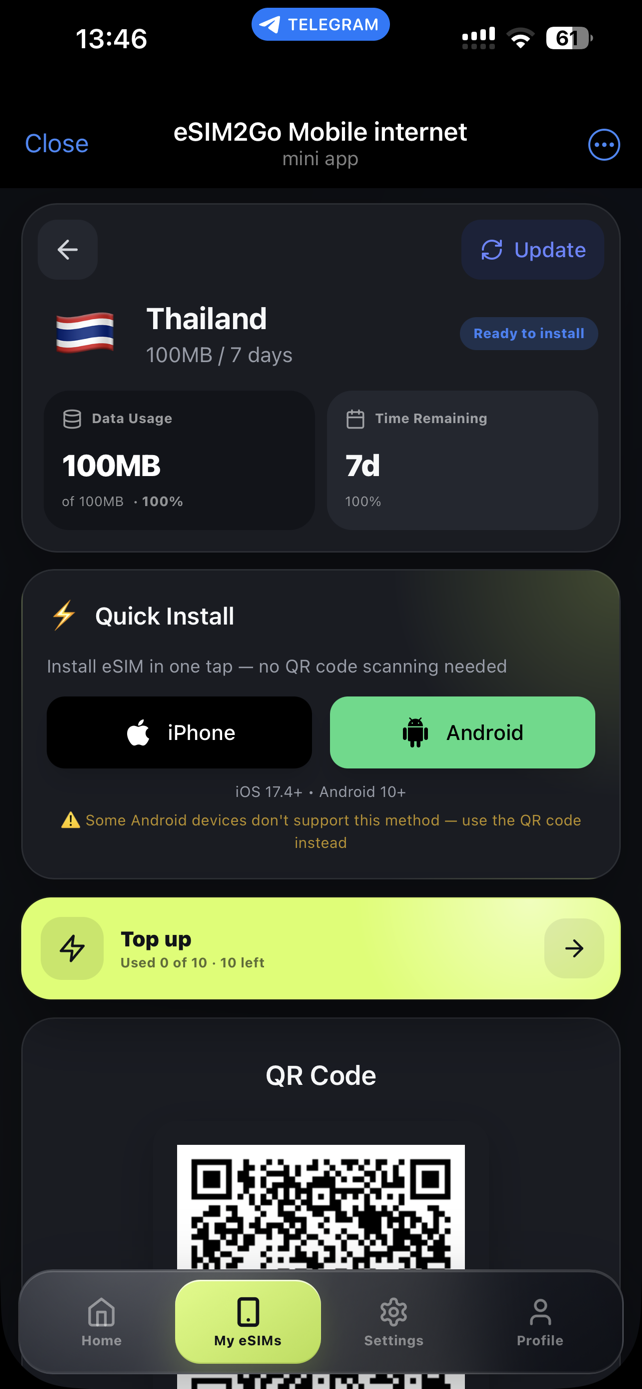
Modern eSIM services use various delivery methods. Telegram, for example, serves as a secure interface where you can browse available plans, receive installation instructions, and manage your eSIM profiles — all in one conversation.
The typical process:
- Open the eSIM provider's interface (web, app, or messaging platform)
- Select your destination country or region
- Choose a data plan that fits your needs
- Complete payment securely
- Receive your eSIM QR code instantly
- Scan the QR code in your phone's settings to install
- Activate when you arrive at your destination
The entire process typically takes 5-10 minutes from purchase to installation. Your eSIM is ready to use the moment you land.
Frequently Asked Questions
Does a global eSIM work in multiple countries?
Yes. Regional eSIM plans (like Europe or Asia packages) work across multiple countries without needing to switch profiles. Global eSIM plans cover even more destinations — perfect for multi-country trips. Check coverage for your specific route before purchasing.
Is international eSIM better than roaming?
For most international travelers, yes. The best international eSIM for travel typically costs 50-80% less than carrier roaming, with predictable pricing. You know exactly what you'll pay before you travel, with no surprise charges when you return home.
Can I keep my home SIM active while using eSIM?
Yes. Most modern phones support dual SIM — your physical home SIM stays active for calls and texts (if you want), while eSIM handles data. You can receive calls on your home number without paying roaming rates for data.
When should I activate my eSIM?
Install the eSIM profile before your trip (while on Wi-Fi at home), but don't enable data until you land. This way you're ready to connect immediately upon arrival, and your data validity period starts only when you first use it.
Does eSIM support calls and SMS?
Most travel eSIM plans are data-only, which keeps costs low. You can make calls using apps like WhatsApp, Telegram, FaceTime, or Skype over your data connection. Your home SIM remains available for traditional calls if needed.
What phones support eSIM?
Most phones released since 2019 support eSIM, including iPhone XS and newer, Samsung Galaxy S20 and newer, Google Pixel 4 and newer, and many others. Check your phone's settings for 'Add eSIM' or 'Add Cellular Plan' to confirm compatibility.
Is eSIM secure?
Yes. eSIM profiles are encrypted and tied to your specific device. Unlike physical SIM cards, eSIM can't be removed and stolen. The QR code used for installation is single-use and becomes invalid after activation.
Can I top up my eSIM if I run out of data?
With most providers, yes. You can purchase additional data through the same interface you used to buy your original plan. No need to visit a physical store or wait for delivery.
What happens if I change phones during my trip?
eSIM profiles generally can't be transferred between devices once installed. If you change phones, you may need to purchase a new eSIM. Keep your original phone available as a backup if possible.
Can I buy eSIM via Telegram before traveling?
Absolutely — this is the recommended approach. You can purchase eSIM through a Telegram eSIM bot, install the profile while still at home on Wi-Fi, and activate when you land. The entire process takes minutes.
Which eSIM Plan Should You Choose?
Use this quick reference to find the best international eSIM for your travel style:
| Traveler Type | Recommended eSIM | Data Amount |
|---|---|---|
| Weekend trip | Country-specific eSIM | 1-3 GB |
| Europe tour (2+ weeks) | Regional Europe eSIM | 5-10 GB |
| Asia backpacking | Regional Asia eSIM | 5-10 GB |
| Digital nomad (1-3 months) | Global eSIM with top-ups | 10+ GB |
| Business traveler | Regional or country eSIM | 5-10 GB |
| Family vacation | Larger data package | 10-20 GB (shared hotspot) |
Consider these additional factors when deciding:
- Trip length — Longer trips benefit from larger data packages with better per-GB rates
- Number of countries — Multi-country trips need regional or global plans
- Data usage — Video streaming and calls need more data than maps and messaging
- Work requirements — Remote work demands reliable speed and sufficient data
- Backup plan — Consider having a second eSIM profile ready for emergencies
Start with a modest plan for your first eSIM experience. It's easy to top up if you need more data, and you'll learn your actual usage patterns for future trips.